Dragon Force (1996) Sega Saturn
An engaging but flawed strategy RPG, and a cautionary tale about trickster spirits
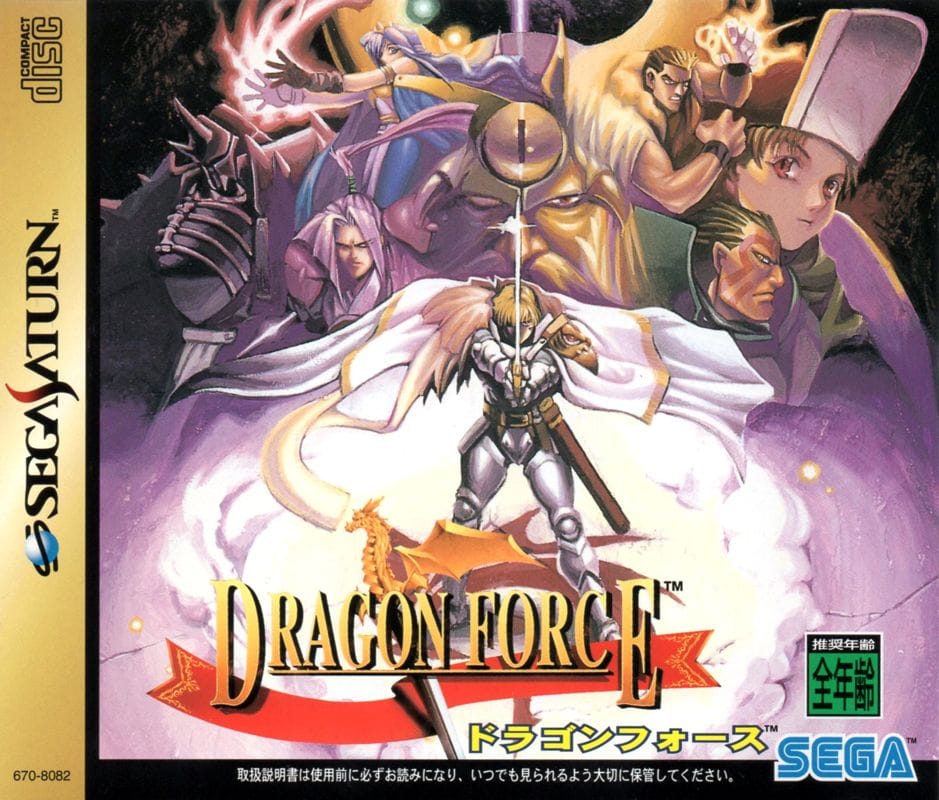
Introduction FMV
There is a dark force rising in the kingdom of Legendra.
Hundreds of years ago, an evil power had made war on the peaceful and prosperous kingdom, attempting to enslave its populace and displace the wise and generous goddesses who ruled it. Out of the ashes, a dragon rose to keep Legendra free. It fought the evil for a thousand days, until, its strength ebbing, it acted to bind the evil force and cast it deep beneath the earth. It was a stalling tactic, to buy Legendra enough time to allow eight dragon warriors to be born. In time, these warriors would rise up and defeat the evil power and its leader, Madruk, before it escaped its tomb.
There is one unknowing dragon warrior in each of the eight kingdoms of Legendra, and war has broken out between them. As the player, your job is to win the war, to find the dragon warriors and bring them together to defeat Madruk.
There's two main components to the game, the overworld map and the battles themselves. Each kingdom starts with a handful of castles, and a few commanders with some troops each. Fairly conventionally, you move these around the map as needed, to take or defend other castles. There's no tutorial, but the mechanics are simple enough to grasp.
The other component is the battles. Each army, with its compliment of troops, faces off individually. The troop types are simple variants, some ranged, or strong against other troop types, or themed to the type of kingdom. You're given a few deployment positions, and a few basic orders such as advance, retreat, disperse or engage. Added to this, the commanders themselves can use magic to damage other troops or commanders. Though they don't engage directly, they will defend themselves in melee combat.
If both sides deplete their troops, it goes to a duel, where the commanders will attack each other in turn until one emerges victorious. The losing commander is usually captured, but otherwise out of the engagement. If time runs out before this, then it's a draw and both commanders are out.
With up to five commanders on each side, there's a distinct strategic element to picking the right one. Some commanders can tank, absorbing damage from a lot of troops, others are more magic oriented. Some are good at duels.
It's simple, but enough to give some tactical control without being time consuming or overmanaged. The battles flow quite well. On a control level, it's not as deterministic as Advance Wars, where there isn't any unit control at all, but not as micro focused as a Westwood title of the same era. Each battle is limited to 90 seconds, which keeps them brisk.
Map and battle example.
When you defeat a kingdom, you recruit its leader into the dragon force pantheon. All this starts in a fairly well paced, straightforward way. Weeks pass in game, about 10 minutes each of overworld real time, between periods of administrative tasks. These tasks are things like upgrading units and recruiting commanders. The first few weeks pass quite smoothly.
Its enjoyable. Your tactics make a difference without the margins being too fine that you need to constantly issue actions to your troops. The game is well presented visually. There's some management of castles and troops but its pretty simple and easy going.
As the player enters the midgame the early pacing begins to fall over itself. It's too hectic. By the midgame, there might be three fronts and a half dozen castles all being fought over. The ten minutes of overworld time are constantly interrupted by one battle after another, so an hour may pass between administrative breaks where you can save the game. This starts to get fatiguing and grinding by the midpoint.
By now, some incongruities have started to show up. For one, the visual style is mostly done after the anime of the time, and looks quite coherent and well done. Amongst these there's some obviously digitised photo commander avatars that simply don't look right. The second is that the dialogue starts to feel very wrong indeed. Of course. It's a Working Designs translation.
Working Designs were a semi-famous, or notorious, group in the 90s and 2000s that translated a number of Japanese Turbografx, Sega and Playstation releases into English. To say translated is sometimes a stretch, as often what they did was replace the original with in jokes, pop culture references, attempts at 'tudey randomness and general inanity. They provoke strong opinions. For games in a fantasy setting, like this or the Lunar series, they seem anathema to them.
In Dragon Force, except for one instance, the translation doesn't quite ruin the game. Mechanically its good enough to withstand it. Yet there's a feeling that the translation degrades it. Its not simply the references. There's a Prozac reference. There's the sole black commander who says 'I'm gon git you sucka'. There's wacky randomness that is neither wacky or random. Its all very tedious, but its not even the worst part of it.
The worst part is that even when its trying to be sincere, the writing standard is awful. I can't speak for the original text, but the translation feels more like a 70s Hong Kong martial arts translation, trying to do it by inference (and space limitations) rather than translating. In cutscenes with multiple characters taking turns, the dialogue is so clunky and unnatural, it seems like they just tried to fill the space however they could.
Even when sincere, the dialogue is awkward.
It's astounding that a company that took on the huge amount of work needed to translate these titles, especially story driven titles and RPGs where writing and character work is so important, then executed it so poorly. Yes, there is a limitation in English that not as much can be said in a limited textual space as Japanese. It feels like they don't even try to make up for this. The attempts at jokes continually break the fantasy world immersion, and even if they didn't, no-one talks the way you would expect. There's no characterisation beyond the absolute basics - some commanders are sweet, some are mean. Its so lazily done. Everyone sounds out of place.
You're left with this impression that a good story could exist in this, but it can't because some commander is making a Chun-Li reference. Like a ruin of a beautiful ancient monument that's covered in soot and dirt.
There's one point in the late game where the translation nearly breaks it.
After defeating the other kingdoms and recruiting the eight warriors, you need to visit three shrines. From there, you get the artifacts you need to defeat Madruk. Only specific warriors can activate the shrines, and the clues you are given are infuriatingly vague, such as "one with the kindness of heaven."
Well, there are at least a few commanders who are priests, and one of the warriors is a priest. You send them to the shrine. Off they trudge across the map, at this point uncontested, but still taking ten or fifteen minutes to traverse one side to another. They get there, and nothing happens.
What it neglects to tell you, is that you need to send all eight warriors, not regular commanders, to the shrines. Three each to two of them, two to the other. They need to be sent as a group, or the shrine does nothing. The corresponding commander is barely related to the clue. "One with a command of water", which could be any of about twenty commanders. Another clue is "one with the ferocity of fire" which could be anyone. Even after looking it up, the clues seem barely related to the actual warrior it refers to.
Imagine the frustration this would cause in 1996, with no gamefaq to refer to. It is a complete failure of the translation.
If the midgame is grindy and overwhelming, this sort of frustration typifies the late. There's some scripted events that need to be completed, in a certain order, to unlock the final battle. This, like looking in the shrines, should be in the middle of the game, completed as the characters progress, rather than all stacked at the end, where you end up watching commanders cross the map several times looking for what to do. The final battle completely loses its tension and anticipation by this.
As you watch them cross slowly from castle to castle, your mind wanders. How did Sega get into this position? What sort of thinking was behind some of its decisions in the 90s? Moreso, what kind of bargain did it strike in its attempt to gain popularity?
You imagine Sega in the 80s, longing for the American market. Hordes of American youth, caps askew or at various angles, skating, boarding or sliding to retailers. The only thought on their mind, the next Sega product. The next commercial expression of attitude. Of coolness. The confirmation, through their purchases, that they are an individual.
But Sega in the 80s was in a pinch. It wanted to be a power in the American market, but it couldn't cut it. Their mascot, Alex Kidd, just didn't have the right vibe. They needed something special, some guiding persona to teach them what Americans wanted, what they craved. What they would buy.
So Sega turned to the occult. This isn't unusual in the corporate world, its how Ronald McDonald, among others, was brought into this realm. The first few attempts at summoning a being were a failure, but the third attempt, with the moon bright and full outside, casting long, blue shadows across the office, was more successful. A sound was heard. A sound that was getting closer.
The sound of a skateboard.
Suddenly, in the space of a bewildered eye blink, Sega is staring at a creature. It was like nothing it had seen before. About five feet tall, blue, with pointy sneakers and white gloves, a sort of animal, but not one that Sega is familiar with.
It stares at him, tapping its foot impatiently.
"Who...who are you?" Sega stammers.
"Me? Well I'm....."
A brief glow illuminates it, and there's a melody in the background, synthetic and simple and catchy. The character strikes a self satisfied pose.
"Sonic the Hedgehog!" it exclaims in time with the melody.
Sega looks around for the source of the music.
"Wait... wait my dude," this Sonic creature is saying, in a high pitched, urgent tone, "I gotta tell you though... something real important..."
"What's that?" Sega fighting, unsuccessfully, to get the nervousness out of its voice. This might be important wisdom.
The Sonic creature puts its hands over its mouth and breathes heavily through them.
"I am your father," it says in a low, muffled tone.
Sonic laughs to itself, in a high pitched giggle, at length.
"No you aren't," Sega replies carefully.
It had read about this in the handbook. Never allow an entity like this to take the upper hand, to define what is true and what isn't. Keep your rational mind intact, and quickly refute its attempts to persuade you of things that aren't true.
Sonic glowers, "well, yea, i was just joshin' with ya, don't have a cow, man," it says in a peevish tone.
This is something Sega had read in the handbook as well. That these entities spoke in riddles, or in non sequitors. That they said things that sounded like language, but weren't.
"Well cmon," Sonic says impatiently, "whatya want?"
"Oh," Sega looks down and consults its notes, "I have an issue with..."
Sega stops, tries again.
"I am a video game company, and I need, I need something special, to become a market leader."
"Well..." Sonic looks curious if not for a slight smirk across its mouth, "what kinda... what kinda mascot you got huh?"
Sega hands over a glossy poster from the latest Alex Kidd game.
"Yeesh," Sonic holds it up with a feigned look of disgust, "what a dweeb. I can see you have some problems Hah hah."
"Would changing him help?" Sega poising to write down notes.
"Weeeeeelllll..." Sonic's eyes narrow slightly, "if you had someone edgier, someone cool, someone hip."
Sega looks eager, "we want to break into the American market."
"Hah hah," Sonic's laughs feel curiously unnatural, as if practiced, "awesome dude I love America, all right! Hollywood razzle and dazzle, make a huge star out of anyone oh yeah showbusiness!"
Sega squints at this, not quite sure what it means.
"You," Sonic, from some furry recess of his person, pulls out a rolodex, "need someone fresh, someone that can help you with... someone who has a lot of 'tude."
It pulls out a card, pretends to check it again, and hands it over.
"This guy," Sonic says, "perfect."
Sega looks at the card. It reads "Sonic The Hedgehog"
"But," Sega says, "that's you...."
"That's right my dude, gimme five!"
Sega hesitates. Is this the price of getting this creatures services? Five what? Sonic's hand is outstretched expectantly.
"Five what?" Sega asks.
Sonic lowers its voice, "and it was that moment that Sonic could tell he had his work cut out for him," it mutters in a narrative voice.
There's an awkward, prolonged silence.
"What do we do?" Sega asks, already feeling off balance, like he might have taken on a bargain that isn't as good as it sounded a few minutes ago.
"We gotta promote, dude, cmon," Sonic's eyes light up, "we gotta be swift and goal oriented, we gotta be razor sharp customer focused on all cutting edge technological outcomes. We gotta cross pollinate the target demographics with targeted advertising of performance proven focused design goals."
Sega just stares.
"It's my own system," the hedgehog says breezily, "I call it 'delivertude'"
"Will you be like Mario?" Sega asks meekly.
Sonic's eyes narrow, "I'm gonna show him."
"Will you want your own game?"
Sonic laughs, "my own game, sheesh, my own single game just for me? Hah."
Sonic leans forward. There is something in its eyes, more of mania than of sparkle.
"My dude, I'm going to need a whole franchise of games," it says, in tones bordering on menacing.
"Okay... and uh..."
Sega consults a list of pre prepared questions.
"The Americans, they think you're.. cool?"
Sonic snorts derisively, "they think Ronald McDonald is cool."
Sega hesitates and looks at another question. Sonic coughs at him pointedly and wags his finger back and forth.
"Questions, dude," it admonishes, "not cool."
"Okay... well," Sega says nervously, "we can try it..."
"Hah hah, all right!" Sonic exclaims, jumps in the air, "well Seags I better go polish off this delivertude, you're going to love it we're going to make so many rings."
The blue glow around the apparition is starting to fade.
"Oh wait," Sonic gets his rolodex out again, "I know these guys, Hah hah, you'll love these guys. They're called Working Designs. They'll spice up, they're some funny dudes, Seags, funny dudes. Americans love them they know all the things on TV they put it in the games."
Sonic flicks a card towards Sega. Sega picks it up gingerly. The card is written in blood.
"Wait.." Sega looks up, "will you always be cool? In the future?"
Sonic laughs dismissively, "I'll always be cool. Like the Simpsons."
The apparition is fading away now.
"The who?" Sega shouts after it.
Sonic's voice, no more than a whisper now, "you'll see..."