The Hand of Compassion: 28 DAYS LATER (2002)
Jim's parents were so certain of their own fate that they chose to die at home rather than hide, flee or fight – they saw the futility of struggle. And yet Jim's mother wrote him a note.
I have to start by saying 28 DAYS LATER is one of my favorite films of all time. I always try to tell people it's not a horror movie per se, it's a romance in a horror setting (that's life, innit?). It's filled with fear, anxiety, confusion and straight-up pants-pissing moments of terror (and chimps, and horses, and apples), but it's not just grimdark gooshy blood and zombies. It's also incredibly tender-hearted and, at its core, a meditation on the constant presence of human compassion.
28 DAYS LATER opens with a break-in in a dark and horrible place: an animal testing lab in England, where chimpanzees are held in glass and metal cages, restrained spread-eagled on tables, with dim lights and violent images flickering and flashing and spasming and exploding on televisions all around them. The metaphor couldn't be clearer: these beasts, these 'unintelligent' cousins of the human ape are soaking in the worst images and sounds of the evils people do to each other. Their purpose in this laboratory is to be infected, killed and studied.
The breakers-in are an animal liberation army, and they are shocked and horrified– filled with pity– by the conditions the chimps are held in, and want to let them out. They do so. It is a very bad idea. The chimps are suffering not only in body but in mind, and they are mad with a virus that is unexplained except for one word: "RAGE". The very catalyst for the chaos and hell of the next 28 days is an act of pity gone horribly wrong.
Jim, a young man, a courier in London, awakens alone and naked in a hospital bed. His awakening is stark and disorienting. He was dead, or near enough as dammit, but he awakens into life and health, alone. You would expect this moment to be dark and terrifying, or noisy, chaotic. But Jim awakens in quiet, with sunlight laying gently across his body. He is born: totally exposed and vulnerable in this moment from non-life into consciousness, into a world he does not understand and cannot make sense of. He blinks into the sunlight.
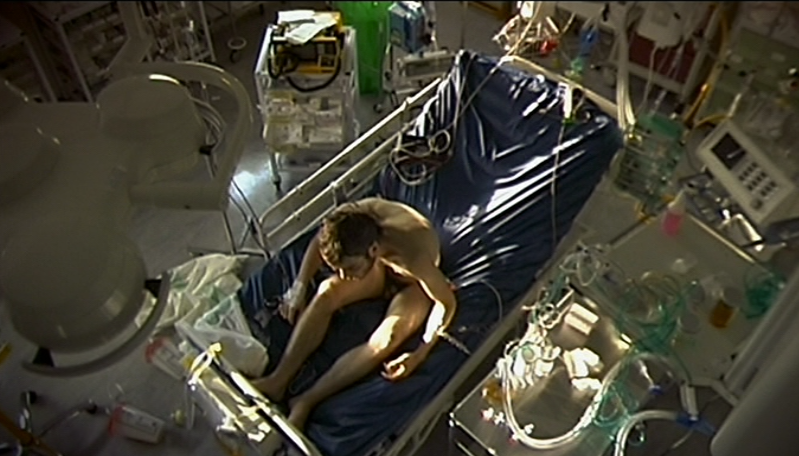
Jim lets himself out of his hospital room and begins his journey back to the human world. The surroundings at first are gentle, empty, sunlit, but ominous in their stillness. Jim has just been born, but he knows enough from his 'past life' to know that this isn't right. There are not only no people to talk to; there are no cars, no phones, no food, no trains, no business, nothing... simply no humans at all, driving the great human machine that has been called London for 1,900 years.
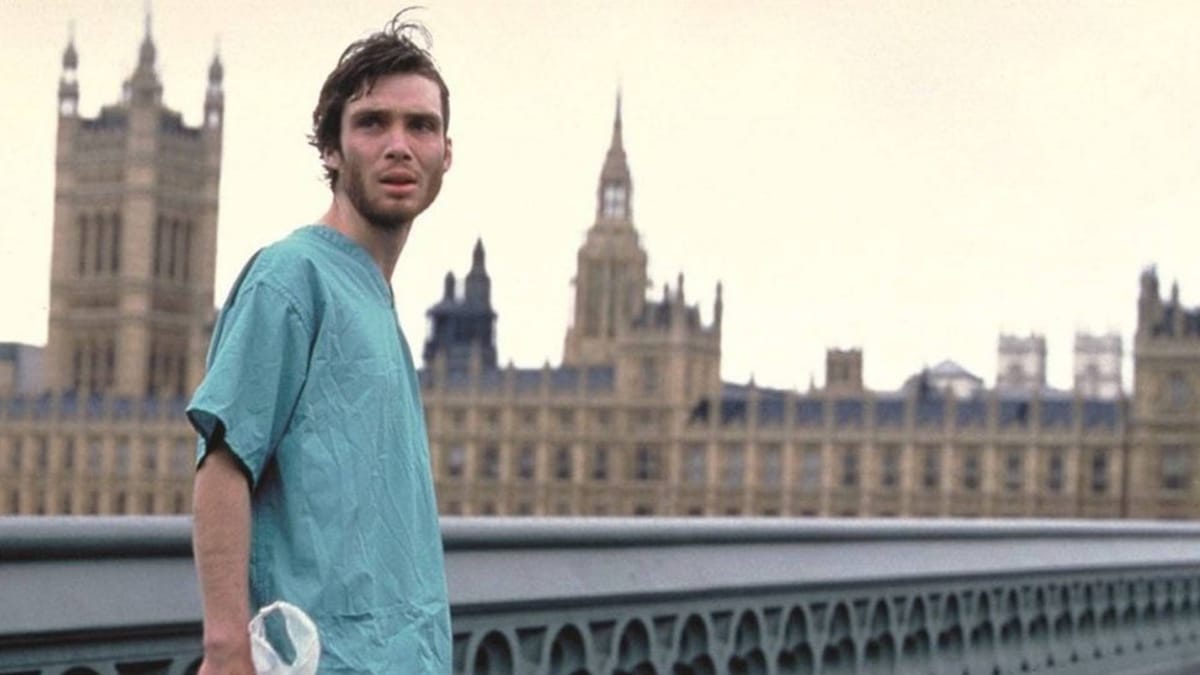
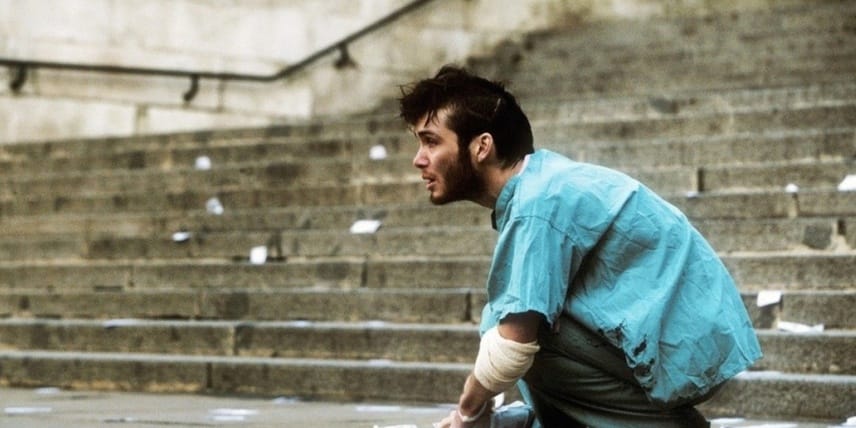
In one of the most goosebump-raising instances of dramatic irony I've ever seen on film, in the midst of this wordless long introduction of Jim wandering out onto the streets of a city that's gone utterly dreamlike, he stumbles upon money lying on the steps of the street. Hundreds of bills, crumpled, blowing gently away in the breeze. As the viewer we feel our hearts clench in realization: if society has entered a moment where cash money has become valueless, if it has happened so quickly that people carried it one moment as absolutely vital and threw it down as useless the next, there is no more terrifying metaphor for immediate collapse. Something happened here.
Jim does not know this, and in the midst of silent madness, he bends down and starts picking up the money. He is confused, almost mindless; Jim bends over to pick up handfuls of cash, which he was so focused on in his 'past life'. A ribbon of bright red blood oozes from the IV hole in his arm, soaking through the bandage. It is the brightest color in the shot. Jim puts the money in his plastic grocery bag and walks on. We never see it again.
Jim was a bike courier: young, pretty fit, a bit rough around the edges. He didn't live with his parents, but "they [not "I"] live nearby". He moved out, but he doesn't have the kind of job that requires a suit, or complicated higher education. Is bike couriering the kind of job that has low responsibility and low demands? I get the impression that Jim was sort of coasting through his life. Maybe he partied a lot, maybe he went round to mates' and played video games. He doesn't have a wife or children, a house, or any friends he ever mentions. He never asks to go back to his own flat. He is not just an Everyman but almost a Nobody.
The first other living thing Jim runs into in this New World is a monster that tries to kill him. He flees in a panic (understandable) and the second living thing he runs into is a man in armor and a gasmask, yelling at him to HURRY, COME ON, RUN!! OVER HERE!
With trust, like a rabbit dashing blind from dogs, Jim follows this man into a dark temporary safety— a kiosk, a convenience store. He finally speaks a few sentences, nearly crying— What’s going on? What are those things? What is happening? The man in the gasmask is tall, looming, dark in the dark, a shadow among blood and shadow, mask eyes glinting flatly, his voice hissing and growling through the mask. Is he mad? “A man walks into a bar with a giraffe. They both get pissed. The giraffe falls over. The bartender says Oi! You can’t leave that lyin’ there! The man says Nah! It’s not a lion… it’s a giraffe.”
Jim is stunned beyond response and this terrifying stranger takes off his mask at last. He’s not a monster or a god. He’s just a man.
“He’s completely ‘umorless,” he says to the woman beside them, then with a touch of bitterness that speaks volumes of this man’s frustration, “You two should get on like a house on fire.” He is Mark, and though his attitude is somewhere between twitchy and protective, he is caring and understanding of Jim, this poor fool that missed the whole thing.
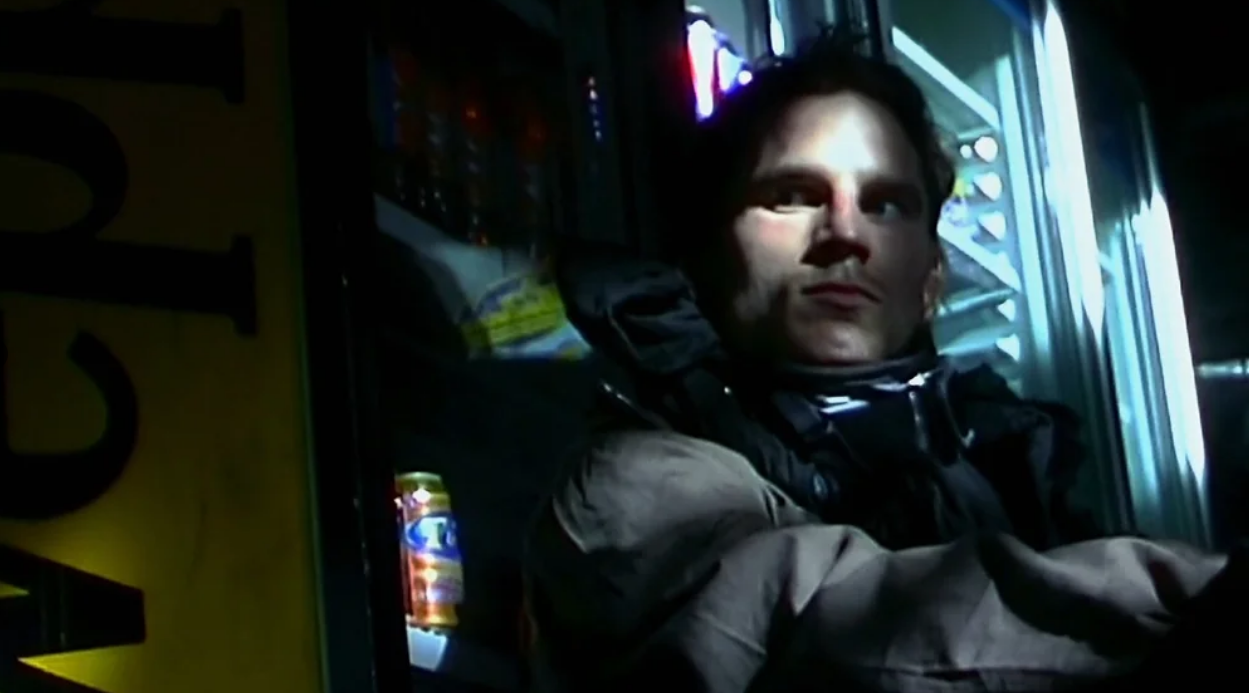
Mark didn't need to risk his life (and Selena's) for this stranger, but he felt a compulsion to rush out and save Jim, who was helpless and alone. Mark has survived an apocalypse for 28 days and resources are slim. He seems to not know Selena that well (considering his little dig at her being unfriendly and cold), so they probably paired up at some point as random chance brought them together. Despite the entire situation of danger, loss and fear, Mark doesn't want to isolate himself; he wants to group up with other humans for as long as he can.
Jim and Selena are beautifully written as foils of one another. Selena is our perfect New Woman for a New World. She is wiry, pissed-off, angry, cold. She is a survival machine. She assures Jim that if he gets infected, she'll kill him in a heartbeat. Nothing is more important than just staying alive – that's all there is. If he falls behind, she's gone. If he slows her down, she's gone. Selena's trauma has turned her into a warrior; but she isn't a knight, she's a paranoid animal backed into a hole.
Jim, on the other hand, literally just got here, and doesn't know all these new rules. He demands they go to his parents' home, which is nearby. Mark and Selena, harshly, try to tell him his parents will be dead, because everyone's parents are dead – Jim is not listening. When they find that his parents are – as they promised – dead, Jim finds it difficult to mourn. He doesn't know what to do. Like so many of us, he needed to see it to feel it, or to believe it. What he sees is evidence that his parents decided to die human, and together, before they could be ravaged by the Rage.
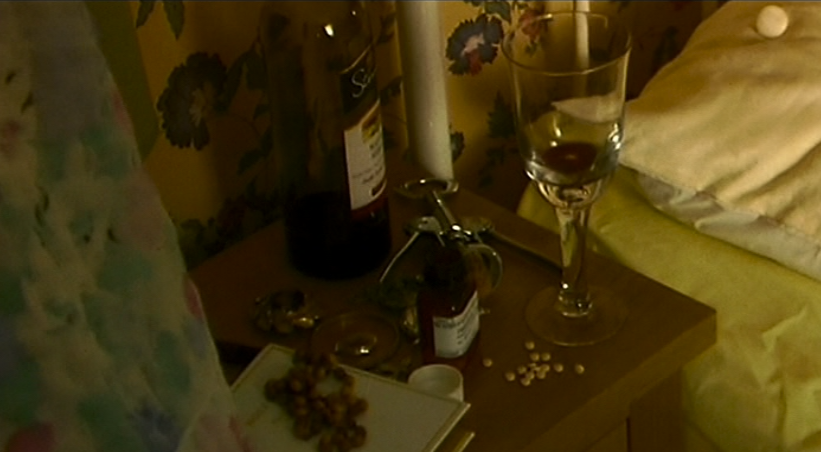
Their bodies are rotting, but there is no horror in their presence. They died together and are incorrupt. In his mother's skeletal hand, Jim finds a photo of himself as a child, with a note.
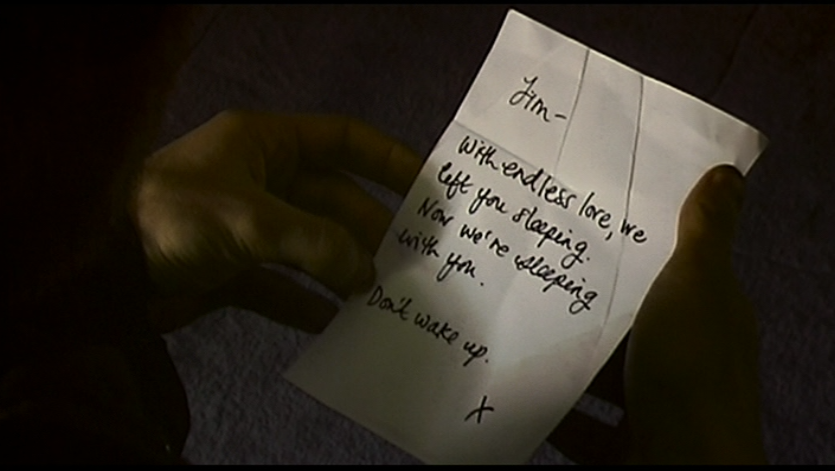
This moment in the film is, to my mind, the emotional kernel of the entire story. Jim was, we piece together, hit by a car in a perfectly unfortunate accident in the course of his job as a courier. He has a shaved patch and scar on his head, and he was in a coma. His parents certainly had no way to know if he would survive, and then the Rage took hold and society collapsed in the span of a moon. They made a decision to leave him in a coma. Did they have any option? Could they ask the hospital to pull the plug, let him go? They were so certain of their own fate that they chose to die at home rather than hide, flee or fight – they saw the futility of struggle. And yet Jim's mother wrote a note; not with a plan, not with expectation. She must have believed that Jim would never survive his wounds, would never escape the hospital, would never come home. This is not a plot ... this is a whisper to the universe. This is just the last murmuring of Hope. In this one scene, endless compassion shines through the whole film.
Jim and Selena soon meet up with Hannah and her father Frank, whose pure and joyous love for each other – only slightly darkened by the loss of Hannah's mother – carries the entire middle section of the film. Hannah is really her father's daughter (perfectly cheeky when she has a mind to be) and Frank's introduction echoes Mark's: a big, terrifying, bellowing man in a hallway, in a mask, shouting for Jim and Selena to HURRY UP, COME THIS WAY, DOWN THE HALL! When he pulls off the armor, we are greeted by Frank's affable, scruffy face. Goodness shines from his smile – he couldn't be more pleased to meet more people in the middle of a terrifying apocalypse. I get the feeling he would be exactly as happy to have a friend over for tea.
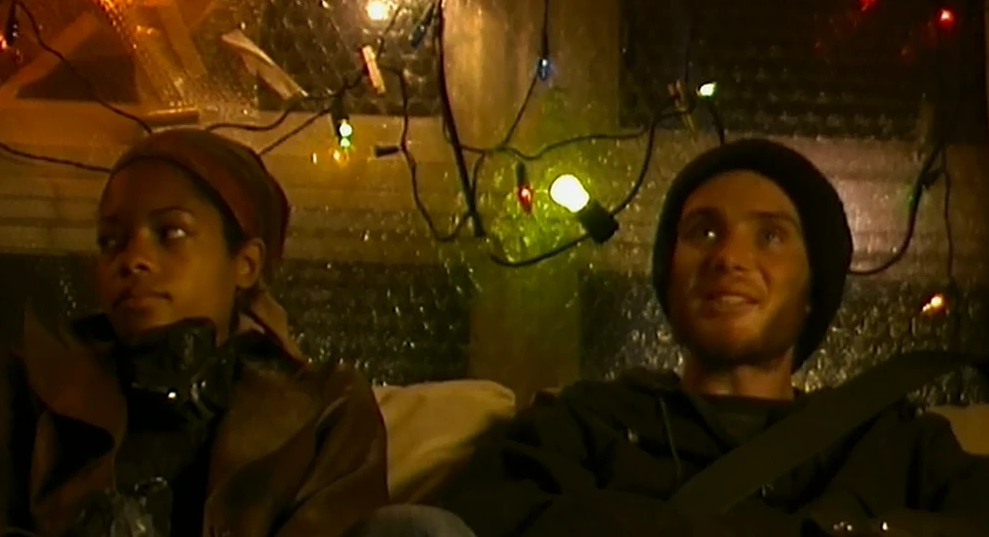
Every new knot of humans in this film is based on similar encounters of struggle, and togetherness, in the face of inexplicable suffering. Even the mad Major West, who determines quickly in his twisted perspective that keeping Jim, Selena and Hannah captive (and enslaved) would be the most Utilitarian solution for humanity, claims to actually be worrying about the happiness of the few men left under his command.
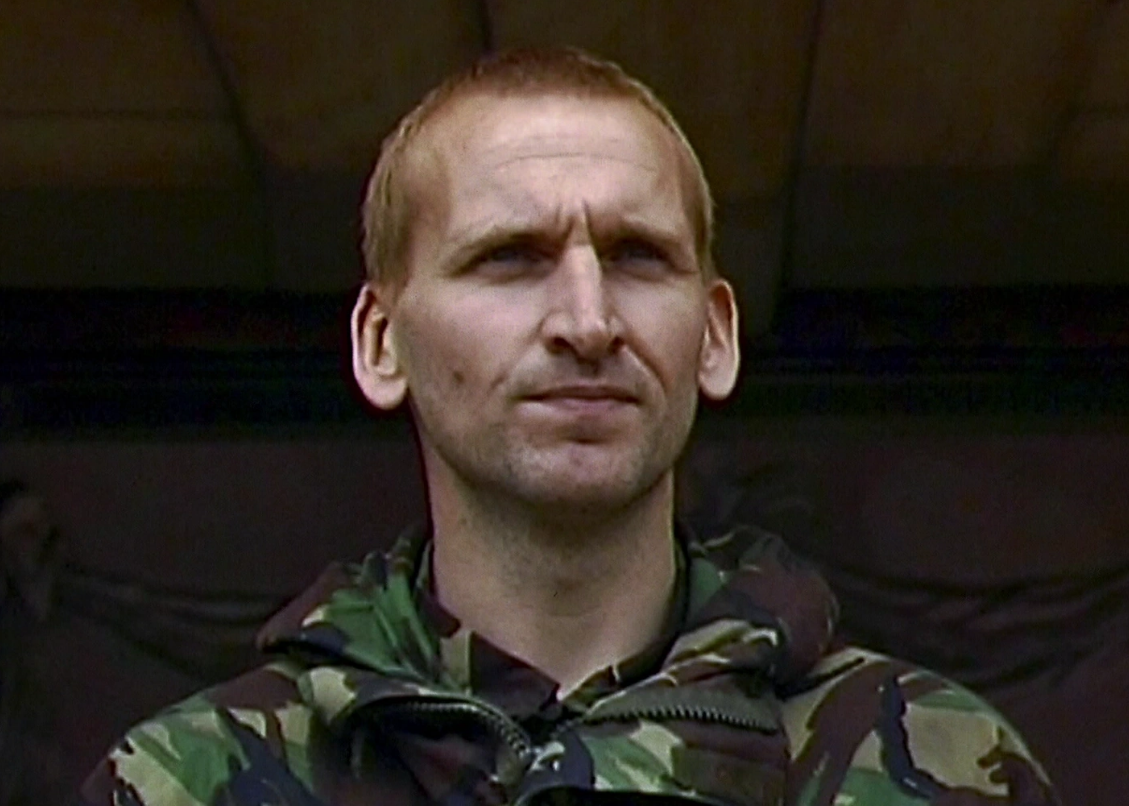
In a New World Order where Major West is pretty damn well off in terms of worldly goods (hot water, food supplies, weapons, vehicles, well-trained and healthy fighters, a secure perimeter), he still cannot provide the few things that will actually keep his men healthy. They are depressed, despairing, and do not get along. They bully and harass one another, their discipline is fraying, and certain individuals are somewhere between desensitized and actively sociopathic. Major West is at the end of his inventiveness. He can no longer just tell them to fall in line Or Else. Or else what? The worst has already happened, hasn't it? How do you prevent total mutiny, total collapse? He begins to tell himself, and them, and later Jim and Selena, that absolutely nothing is out of order. To his mind, his entire career and the last month is nothing more than "People killing people. Which puts us in a state of normality right now."
But he knows the reason that "normality" existed was because there was a larger structure around even war and conflict; that somewhere away from the battlefield are governments, families, trains, supermarkets, banks, all clicking along, and he was doing his part. Without that structured society functioning in the background, there no longer is any purpose to "people killing people"– there is no longer a battle to be won or land to be captured. There is no society. He admits, very quietly, to Jim, trying to bring him round to the idea, that without women there is no future ("I promised them women."). Jim runs out of the room without a word. Major West lets him go. What can one man do, after all, against a dozen heavily-armed soldiers who are ready to take what they want?
Jim gets Hannah and Selena out of the clutches of the military mob, but is shot during their escape. His stuttering consciousness blinks, sags, flutters into darkness, leaving his trust and his fate in the hands of Hannah and Selena. They are his only family now, his found family. He slides away into nothingness.
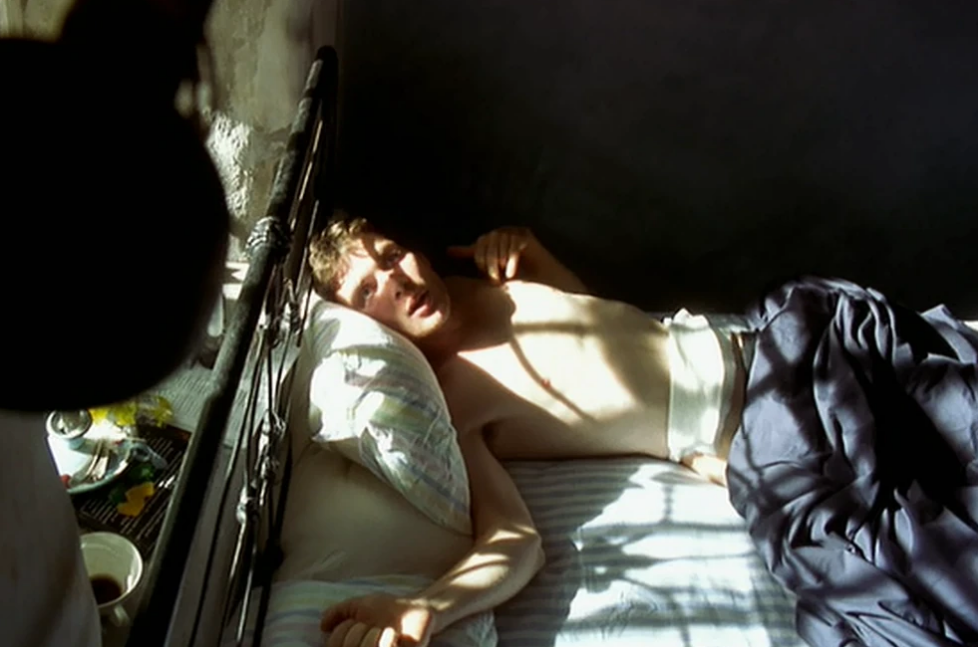
Jim, a young man, a courier from London, awakens alone and naked in a farmhouse bed. His awakening is stark and disorienting. He was dead, or near enough as dammit, but he awakens into life and health, alone. You would expect this moment to be dark and terrifying, or noisy, chaotic. But Jim awakens in quiet, with sunlight laying gently across his body. He is born: totally exposed and vulnerable in this moment from non-life into consciousness, into a world he does not understand and cannot make sense of. He blinks into the sunlight.
He remembers. He goes downstairs to greet Selena and Hannah under a blue sky filled with hope.
But before we turn the page on Jim, Selena and Hannah's quiet triumph, I want to carry you back to the hospital room that Jim woke up in at the beginning of the film. Jim was left in that bed, IVs inserted, door secured against the dark horror outside, and that is where he woke up 28 days later. He was safe, uneaten: locked in. Jim let himself out of the hospital room and walked down the hallway, calling "Hello?" to people who would never answer.
But wait: Who locked the door? Surely, a nurse or orderly, of course. And not until the very last moment, not until someone was certain that there was no other possibility of evacuating or hiding, with Infected banging at the windows, screaming in the streets. Someone, some unknown hospital worker, locked that door of that room. And slid the key under the door for Jim.
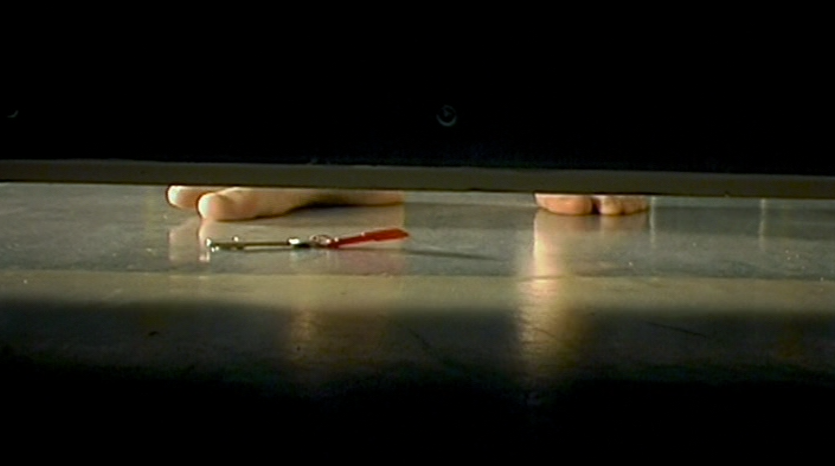
Who could predict if Jim would ever awaken from his coma? He was not even stable enough to remove the IVs, and his family were not present. But some nurse locked the door on the living patient in that room, and pushed the key underneath. There could not have been an expectation that he would need it. This was not a plan. This was a whisper to the Universe: if he awakens, if none of us are here, I will leave him a path forward. No expectation ... just a thread of Hope.
Personal rating: 10/10, A beautiful movie that continually reveals more every time I watch it.
This article was written by a real human without any use of AI.